
WHY NOT SAVE MONEY AND DO MOLD TESTING YOURSELF?
What Will a $20 Mold Test Kit Really Tell You?
By Kevin Buck
Master Certified Services
Call or text: 218-464-8315
Let’s be honest. For about $20, a do-it-yourself mold kit gives you a plastic dish, some growth material and an answer you already know: YOU HAVE MOLD!
There ARE mold spores in your home!
There are millions of them floating in the air and you can't see them because they're so small. Leave the sampling dish uncovered long enough and something will probably grow.
Mold normally lives outdoors and releases microscopic spores into the air. These spores enter houses through windows, doors and ventilation systems. They are also carried indoors on clothing, shoes, packages and pets.
As a result, virtually every home contains some mold spores.
The question is not simply:
“Do I have mold spores in my home?”
The questions homeowners actually need answered are:
What kinds of mold are present?
How much is present?
Are certain rooms higher than others?
Do the results suggest that mold is growing indoors?
Where is the moisture allowing it to grow?
What should the homeowner do next?
A basic do-it-yourself mold plate cannot answer most of those questions.
How Does a DIY Mold Kit Work?
Most inexpensive kits contain a shallow plastic dish filled with material that allows certain molds to grow.
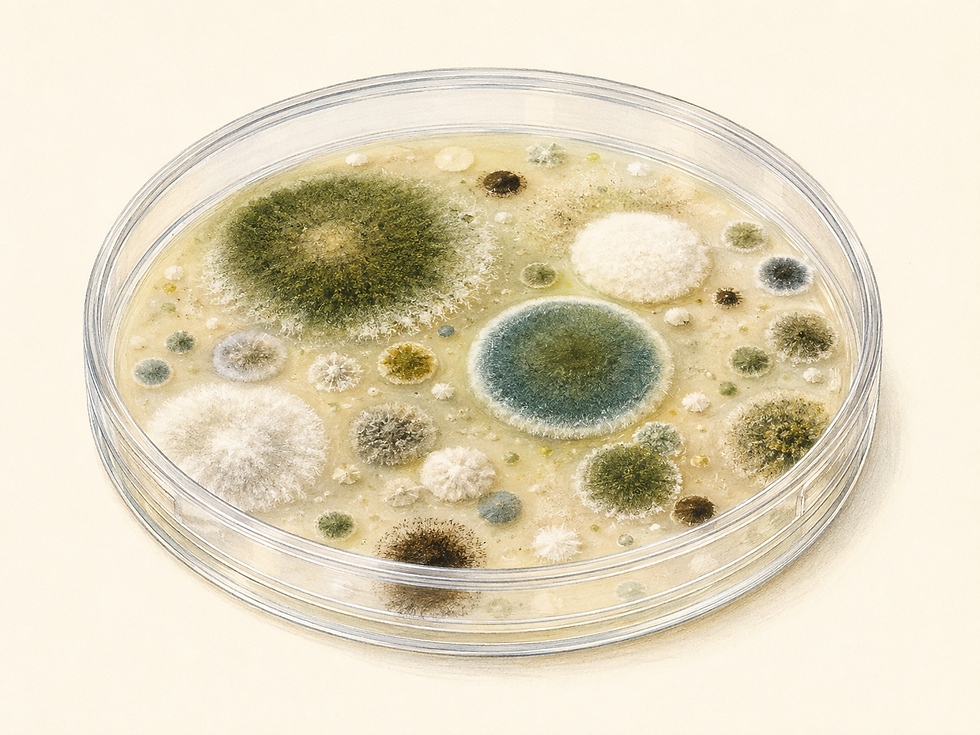
You remove the cover and leave the dish exposed to the room. Mold spores and other particles settle onto the plate. If viable spores land on it and conditions are favorable, visible colonies may begin growing several days later.
The plate may develop colorful spots that look impressive—or frightening.
However, the test has demonstrated only that living mold spores landed on the plate and grew.
Growing mold is not the same as measuring mold.
What You Get—and What You Don’t Get
What you may receive | What you should not expect |
An inexpensive test that is easy to use | A complete mold investigation |
Visible mold colonies growing in a dish | Proof that the home has an abnormal mold condition |
Evidence that viable spores landed on the plate | A measurement of airborne mold concentration |
Optional laboratory identification | Laboratory analysis included in the advertised price |
An interesting household experiment | Identification of the moisture source |
A result that may encourage further investigation | Information showing where concealed mold is growing |
General information about cultured mold | Professional interpretation or practical next steps |
Why Doesn’t the Plate Measure Mold in the Air?
Professional air testing uses a calibrated pump to pull a known amount of air through a collection cassette.
Because the amount of air is known, a laboratory can estimate the concentration of mold spores in spores per cubic meter of air. Results from different rooms can then be compared using the same measurement.
A do-it-yourself plate does not collect a measured amount of air. It collects only the particles that happen to fall onto it.
Its result may be affected by:
Where the plate is placed
How long it remains uncovered
Open windows or doors
Heating and cooling equipment
People walking through the room
Vacuuming or cleaning
Temperature and humidity
Differences in the size and weight of mold spores
How quickly different molds grow
Some spores settle more easily than others. Some molds grow rapidly and overwhelm slower-growing colonies. Other mold particles may be present in the air but never grow inside the dish.
What appears on the plate is therefore not a complete measurement of what was floating in the room.
What Happens When You Send the Plate to a Laboratory?
Some kits allow the plate to be mailed to a laboratory for an additional charge.
The laboratory may identify the mold that grew inside the dish. However, it still cannot determine:
How much mold was present in the room’s air
Whether the plate was placed in the correct location
Whether the result represents normal indoor conditions
How one room compares quantitatively with another
Whether mold is growing behind a wall
Where moisture is entering the building
How extensive the problem may be
Whether professional remediation is necessary
The laboratory analyzes what you send.
It cannot inspect your home, locate hidden moisture or correct a poor sampling plan.
Does DIY Testing Really Save Money?
A $20 kit sounds inexpensive until the homeowner tries to test an entire house.
A home may contain several bedrooms, common areas, bathrooms, a basement and a heating and cooling system.
Testing these areas may require multiple kits. Add laboratory analysis and shipping for each plate, and the original $20 experiment can become much more expensive.
Even after paying those charges, the homeowner may still lack:
Measured air samples
Mold concentrations
Reliable room-to-room comparisons
Moisture readings
An inspection for concealed damage
Identification of likely mold sources
Professional interpretation
Recommendations for what to do next
By the time you purchase several kits and pay laboratory fees, you may have spent hundreds of dollars on colorful dishes that still cannot explain what is happening inside your home.
DIY Kit Versus Professional Testing
DIY mold plate | Professional mold testing |
Collects particles that happen to fall | Collects a measured volume of air |
Shows that viable mold spores are present | Identifies mold categories and estimated concentrations |
Does not provide spores per cubic meter | Provides quantitative laboratory results |
Cannot reliably compare rooms | Allows consistent room-to-room comparison |
Does not establish an outdoor baseline | Can include an outdoor control sample |
Does not inspect the building | Includes investigation of building conditions |
Does not measure moisture | Uses moisture instruments to locate damp materials |
Cannot locate concealed growth | Helps identify likely areas of concealed mold |
May provide general laboratory identification | Includes professional interpretation |
Often creates additional questions | Is designed to provide useful answers |
Why Does Professional Experience Matter?
Professional mold testing begins with an investigation—not a plastic dish.
Before collecting samples, the inspector should consider:
Previous water damage
Current or previous moisture sources
Musty odors
Visible staining
Damaged building materials
Moisture readings
Areas where mold may be concealed
Heating and cooling equipment
Concerns reported by the occupants
The inspector then selects sample locations and testing methods based on the questions the homeowner needs answered.
A sample collected in the wrong location can miss the problem entirely. A sample collected near an open window may reflect outdoor conditions more than indoor growth.
The laboratory cannot correct a poor sampling plan.
Why Independence Matters
A potential conflict can exist when the same company performs the testing, recommends remediation, completes the cleanup and then evaluates whether its own work succeeded.
That does not automatically mean the contractor is dishonest. It does mean the contractor may have a financial interest in the outcome.
An independent testing company does not earn more money by recommending a larger remediation project.
The person measuring the problem should not profit from making the problem larger.
When Is a DIY Kit Appropriate?
A settling plate may be useful as:
An educational experiment
A demonstration that mold spores exist in ordinary air
A way to satisfy curiosity
A classroom science project
It should not replace a professional investigation when:
Mold is suspected but not visible
A persistent musty odor is present
The home has experienced water damage
Occupants have exposure concerns
Different rooms need to be compared
A major cleanup decision must be made
Testing is needed after remediation
A buyer or seller needs objective information
The Bottom Line
What Are You Really Buying?
When you hire Master Certified Services, you are buying more than samples and a laboratory report. You are buying peace of mind—professional testing, independent laboratory analysis and a clear explanation of your property’s mold conditions.
A $20 DIY kit means gambling on the equipment, your sampling locations and your ability to interpret the results.
Are you willing to stake your family’s health and your property on a plastic dish?
The DIY kit gives you mold.
Professional testing gives you answers.
Do You Have Questions About Mold in Your Home?

Schedule a free, no-obligation telephone consultation.
Kevin BuckMaster Certified ServicesCall or text: 218-464-8315
Information furnished by Master Certified Services of MN, LLC. This article provides general consumer information. Mold testing evaluates environmental conditions and does not diagnose illness.


Comments