
All about Professional Mold Testing
By Kevin Buck
Master Certified Services
Call or text: 218-464-8315
What Is Mold?

Mold is a living organism belonging to the fungus family. It normally lives outdoors, where it performs an important job by helping break down dead trees, fallen leaves and other natural material.
Mold reproduces by releasing extremely small particles called spores. These spores travel through the outdoor air and enter houses through doors, windows and ventilation systems. They are potentially harmful to some people and pets They can also be carried indoors on clothing, & shoes.
As a result, some mold spores are found in virtually every home.
Usually, these spores remain part of the ordinary air and household dust without becoming a significant problem. However, when water or excessive moisture is present, mold spores may begin growing inside the building.
Mold can establish colonies on many materials, including:
Drywall
Wood
Insulation
Carpet and carpet padding
Ceiling tiles
Base trim
Wallpaper
Fabrics
Concrete block
Household dust
Once mold begins growing indoors, it can release additional spores and microscopic fragments into the air. People and animals may then breathe these particles, swallow particles that settle on food or surfaces, or come into direct contact with contaminated materials.
What Are Mycotoxins?
Some types of mold can produce chemical compounds called mycotoxins. These substances may help mold compete with other organisms or discourage insects, microbes and other natural predators from consuming it.
You might think of this as a chemical defense mechanism. A cobra or rattlesnake uses venom to defend itself or capture prey. Certain molds can produce chemical compounds that improve their chances of survival.
The comparison is not exact. A snake injects venom, while mold does not intentionally inject mycotoxins into people or animals. The comparison simply helps explain why a seemingly simple fungus can produce biologically active chemicals.
Not every mold produces mycotoxins. A mold capable of producing them also does not necessarily produce them under every condition.
When mycotoxins are present, they may be associated with mold spores, microscopic mold fragments, contaminated dust, contaminated food or materials on which mold has been growing.
Why Do People Respond Differently?
Some people and animals have immune systems that are more sensitive to mold than others. Age, allergies, asthma, existing lung problems and the condition of the immune system can all affect how someone responds.
People who are sensitive to mold may experience:
Sneezing
Stuffy or runny nose
Sore throat
Coughing
Wheezing
Shortness of breath
Red, burning, itchy or watery eyes
Skin irritation or rash
Headaches
Worsening asthma symptoms
The Centers for Disease Control and Prevention, commonly called the CDC, is the federal public-health agency that studies illnesses and provides health and safety information to the public. The CDC reports that mold may cause breathing problems, eye irritation, skin irritation and allergy-like symptoms in sensitive people.
The Environmental Protection Agency, commonly called the EPA, is the federal agency responsible for protecting people and the environment from environmental hazards. The EPA provides information about indoor air quality, mold, moisture and safe mold-cleanup practices.
The EPA explains that mold may irritate the eyes, skin, nose, throat and lungs—even in some people who are not allergic to mold.
What About Your Pets?
Pets may also be affected. Young animals, older animals and pets with existing health problems may be more vulnerable.
Warning signs can include:
Coughing or sneezing
Irritated or watery eyes
Unusual breathing difficulty
Tiredness or weakness
Loss of appetite
Vomiting or diarrhea
The Food and Drug Administration, commonly called the FDA, is the federal agency responsible for the safety of food, medicines and animal food. The FDA warns that pets consuming food contaminated with certain mycotoxins can suffer serious illness, including liver damage.
These symptoms do not prove that mold or mycotoxins are responsible. Many illnesses can produce similar symptoms.
Mold inspection and testing evaluate conditions inside a building. Physicians and veterinarians determine whether a person or animal is sick and what may be causing it.
Why Do We Test Homes for Mold?
To determine if the home is safe to occupy.
I'm not doing that anymore you have to give me a refund for all that you've collected before I do that again
The reason we test for mold is to understand the conditions that exist inside the home.
Homeowners usually want answers to several basic questions:
What kinds of mold are present?
Are some rooms showing higher concentrations than others?
Do the results suggest that mold may be growing inside the building?
Does visible discoloration contain mold?
Could the heating or cooling system be distributing mold particles?
Is additional investigation or professional cleanup appropriate?
No single mold sample can certify that an entire building is completely safe for every person or animal. People have different health conditions and sensitivities, and there are no universal federal limits defining a safe concentration for every type of mold.
Testing provides evidence. That evidence must be considered alongside:
The building inspection
Moisture measurements
Visible growth
Water-damage history
Musty odors
Locations where samples were collected
Differences between rooms
Outdoor mold conditions
Concerns reported by the occupants
What Types of Mold Tests Are Available?
Some tests measure mold spores in the air. Other tests identify mold growing on a particular surface. Moisture instruments help locate the water or dampness that allows mold to grow. No single test tells the complete story.
Indoor "Air Sample"
What is it?
An indoor air sample collects microscopic mold spores floating in the air inside a particular room.
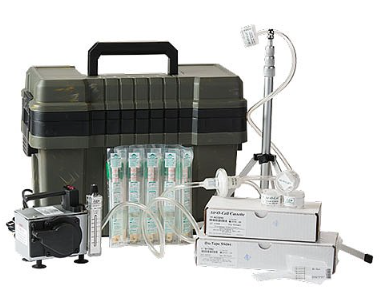
A small vacuum pump pulls a measured amount of air through a collection device called a spore-trap cassette. Air passes through the cassette, but mold spores and other airborne particles stick to a collection surface inside it.
The cassette is sealed and sent to a laboratory for examination.
What result can you expect?
The laboratory report generally identifies:
Types or groups of mold spores found
Number of spores counted
Estimated concentration of each mold category
Total estimated mold-spore concentration
Percentage contributed by each mold category
Comments about the condition of the sample
The concentration is generally expressed as spores per cubic meter of air. This provides a consistent way to compare samples from different rooms.
What does it tell us?
An air sample provides a snapshot of what was floating in that room’s air during the sampling period.
It helps answer:
What kinds of mold spores were present?
Approximately how many were present?
Was one room higher than another?
Were particular indoor molds unusual compared with the outdoor sample?
An air sample cannot guarantee that concealed mold is absent. Mold growing inside a closed wall may not release detectable spores into the room during the brief sampling period.
Outdoor Control Sample
What is it?
An outdoor control is an air sample collected outside the home using the same equipment and general method used for the indoor samples.
Why is it needed?
Mold naturally lives outdoors. Outdoor spores enter homes through ordinary air movement, open doors and windows, clothing, shoes and pets.
The outdoor sample provides a background comparison for the indoor samples.
What result can you expect?
The laboratory reports the types and concentrations of mold spores found in the outdoor air.
The inspector can then compare:
Indoor and outdoor mold categories
Indoor and outdoor total concentrations
Individual rooms with outdoor conditions
Mold found indoors but absent or uncommon outdoors
Outdoor mold levels change with the weather, season, wind, rain, snow and surrounding vegetation. The outdoor sample provides useful context, but it is not a universal pass-or-fail standard.
Surface Swab

What is it?
A surface swab looks similar to a cotton swab. It is rubbed across visible mold or a suspicious area and then sealed and sent to the laboratory.
Where might it be used?
A swab may be collected from:
Basement block
Drywall
Base trim
Wood framing
Window areas
Cabinets
Heating or cooling equipment
Other suspicious surfaces
What result can you expect?
The laboratory examines the collected material and identifies the mold categories found on that particular surface.
A swab can help determine whether suspicious discoloration is actually mold.
What does it not tell us?
A swab does not measure how much mold is floating in the room’s air. It also does not determine how far the mold extends beyond the small area that was sampled.
Tape-Lift Sample
What is it?
A piece of clear adhesive material is pressed against a suspicious surface. Mold spores, fragments and growth structures stick to the tape.
The tape is then protected and sent to the laboratory for microscopic examination.
When is it useful?
Tape-lift samples are useful when suspected growth is:
Visible
Accessible
Located on a relatively smooth surface
Dry enough to adhere to the tape
What result can you expect?
The laboratory can identify fungal material collected from that location and determine whether mold-growth structures are present.
Like a swab, a tape lift evaluates one particular surface. It does not measure airborne concentrations or determine the complete size of the affected area.

Bulk Material Sample
What is it?
A small piece of building material is removed and submitted directly to the laboratory.
Examples include:
Drywall
Insulation
Carpet
Carpet padding
Wood
Ceiling tile
Wallpaper
What result can you expect?
The laboratory examines the submitted material and reports whether fungal growth or mold spores were observed.
The result applies only to the piece submitted. Because collecting a bulk sample requires removing material, it is not necessary or appropriate in every investigation.
Moisture Measurement
Is this a mold test?
No. A moisture meter does not identify mold. It helps locate damp building materials and conditions that can allow mold to grow.
How does it work?
The meter is placed against or inserted into building materials such as drywall, wood, trim or flooring.
Depending on the instrument, it provides:
A moisture-content reading, or
A comparison showing that one area is wetter than another
Provides atmospheric readings for the building which tells you whether you have conditions favorable for mold growth.
What result can you expect?
Moisture measurements may help:
Locate the boundaries of water damage
Find damp materials that feel dry
Compare suspected areas with known dry areas
Determine where mold testing may be useful
Monitor whether materials are drying
Metal, electrical wiring, salts and differences among building materials can sometimes affect readings. The equipment must be used and interpreted correctly.

Relative Humidity and Temperature
What is being measured?
A humidity meter measures the amount of moisture in the air. It usually also measures temperature.
What does it tell us?
The readings help determine whether current conditions may encourage condensation or mold growth.
High humidity does not prove that mold is growing. Normal humidity also does not rule out mold resulting from an earlier leak or concealed water problem.
Visual Inspection
Is this a laboratory test?
No, but it is one of the most important parts of a professional mold investigation.
The inspector looks for:
Visible growth
Discoloration
Water stains
Damaged materials
Musty odors
Condensation
Plumbing or roofing problems
Foundation seepage
Areas where mold may be concealed
Conditions that may affect the test results
Laboratory testing is most useful when it is connected to an investigation of the building.
Quick Guide to Testing Methods
Testing method | Basic question it answers |
Indoor air sample | What mold spores were present in this room’s air, and approximately how much? |
Outdoor control sample | What mold spores were present outside for comparison? |
Surface swab | What was collected from this particular surface? |
Tape-lift sample | Is fungal material present on this visible area? |
Bulk material sample | Is mold present on or inside this submitted piece of material? |
Settling plate | Did viable mold spores land on the plate and grow? |
Moisture meter | Where are building materials damp or unusually wet? |
Humidity measurement | Are current air conditions favorable for condensation or mold growth? |
Visual inspection | Where are the visible warning signs, moisture sources and suspicious conditions? |
How Many Samples Should Be Collected?
There is no single number that is correct for every home.
The sampling plan should consider:
Size and layout of the house
Number of occupied living spaces
Number of occupants
Number of floors
Basement or crawl-space conditions
Previous water damage
Visible growth
Musty odors
Separate heating or cooling systems
Concerns reported by the occupants
Available testing budget
Questions the homeowner wants answered
Our general preference is to collect one air sample in each major occupied living space when the homeowner wants a comprehensive evaluation.
Surface samples can then be added for:
Visible mold on basement block
Discoloration on base trim
Suspected growth on drywall
HVAC components
Other accessible suspicious materials
Bathrooms deserve individual consideration because they regularly experience humidity, condensation and plumbing leaks. Whether each bathroom needs an air or surface sample should depend on its condition, ventilation, odors, visible growth and water history.
Example Sampling Plans
These are starting points, not rigid requirements. The final sampling plan should be based on the inspection, the homeowner’s concerns and the available budget.
Home size and layout | Possible air-sampling plan | Possible surface samples |
Small two-bedroom home with two bedrooms and two common areas | Four indoor air samples plus one outdoor control | Zero to two targeted surfaces |
Three-bedroom home with a basement | Five to seven indoor samples plus one outdoor control | One to three targeted surfaces |
Four-bedroom home with a finished basement | Eight to ten indoor samples plus one outdoor control | Two to four targeted surfaces |
Four- or five-bedroom home with a full basement | Ten to fourteen indoor samples plus one outdoor control | Two to five targeted surfaces |
Investigation focused on one suspected area | Suspected room, comparison area and outdoor control | One or more targeted surfaces |
A larger home might contain:
Two upstairs bedrooms
Two basement bedrooms
Living room
Dining room
Kitchen
Basement recreation room
Bathrooms
HVAC or mechanical area
Sampling every room provides more information, but it also increases the cost. The homeowner and inspector should decide which locations are most likely to answer the important questions.

Controlling the Cost
The number and type of samples should provide enough information to answer the homeowner’s questions while respecting the available budget.
Before scheduling, Master Certified Services provides an estimated price range based on:
Size of the home
Number of living spaces
Areas of concern
Anticipated laboratory samples
Property location and travel requirements
Access to attics, crawl spaces or other difficult areas
The inspector should be able to explain what each proposed sample may contribute to the investigation.
The Bottom Line
Master Certified Services provides independent mold inspection, testing, consultation and laboratory-report interpretation.
We do not perform mold remediation. Our recommendations are not influenced by selling demolition or cleanup work.
Have Questions About Mold in Your Home?
Schedule a free, no-obligation telephone consultation.
Kevin BuckMaster Certified ServicesCall or text: 218-464-8315
Information furnished by Master Certified Services of MN, LLC. This article provides general consumer information. Mold testing evaluates environmental conditions and does not diagnose illness or guarantee that a building is safe for every individual.


Comments